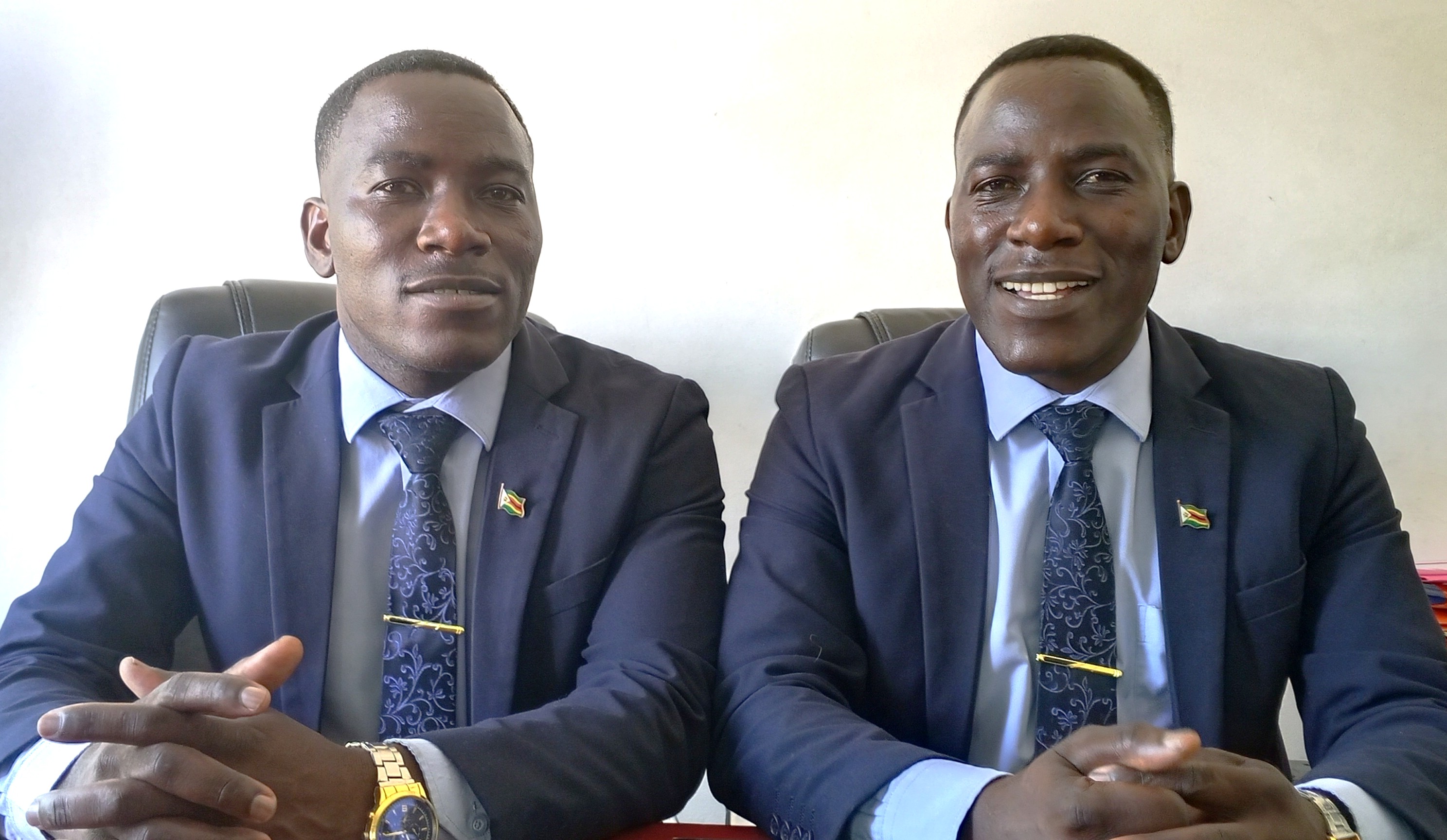
Anyone who lives with or is close to identical twins can attest that the experience can feel like studying the exact same topic every single day.
This is precisely how it feels to interact with Chitungwiza twin brothers Tendai Mayor Katonha and Farai Lawyer Katonha, founders of the Twin Association of Zimbabwe (TAZI), Founders of Southern Africa Twins Organizations (SATO) and Presidents of Africa Twins Association Board.
Born in Mudzi District, the Katonhas have carved out a rich history together, spanning careers briefly recruited in the Zimbabwe National Army, then 17 years in the police force, public prosecution, and now as accomplished lawyers.
Yet the most excruciating confusion one encounters with this pair is astonishing: they are of the exact same height, stature, and complexion, making telling them apart a complex task.
Adding to the intrigue, both brothers are married to identical twin sisters. To prevent confusion within their own household, they resolved early on to build a culture of absolute unity.
This publication caught up with the brothers following their latest achievement: graduating with LL.B. degrees in law.
Chaos in Uniform
Looking back at their days in the Zimbabwe Republic Police (ZRP), when both were stationed at ZRP Chitungwiza, their resemblance was a constant source of public outcry and mistaken identity, confusing suspects, colleagues, and members of the public alike.
Recalling a 2010 incident, Mayor shared:
"I still recall we were in different offices—one assigned to investigations and the other attached elsewhere.
A complainant came looking for his investigating officer and was pointed to me. I told him I was not the person he was looking for and asked him to check with my twin brother.
"His response was furious. He accused me of dodging him and complained to the Officer-in-Charge that I was refusing to assist him because I had a personal issue with him.
When he returned with the Officer-in-Charge, he saw us standing together. Upon being asked to point out who had actually taken his case, the complainant failed completely."
For Lawyer, a 2012 incident remains vividly etched in his memory:
"We fired a warning shot in Unit L after an altercation with some security personnel. We wanted to arrest them for public drinking while on cycle patrol as a team of four. When the suspects were asked to identify which of us had fired the gun and arrested them, they could not do it."
When asked how serving in law enforcement prepared them for their current careers, Lawyer noted:
"Serving as police officers for over 17 years molded us in a unique way. Understanding powers of arrest and evidence gathering gave us a major head start."
Mayor added, "Compiling dockets also helped us immensely when we moved into prosecution and case building."
Tormenting the Courtroom
Their tenure as Public Prosecutors (PPs) at the Chitungwiza Magistrate Court brought similar chaos.
Magistrates and defense attorneys frequently mistook one brother for the other during trials.
"Starting with the magistrates—at one point, they went to report us to the Regional Public Prosecutor, Mr Kumire, stating that we were confusing the court," Mayor said.
"They were worried that one of us might step in for a case the other was actually handling.
"They sought an order instructing us to dress differently. We were summoned to Mr Kumire’s office and instructed to wear different ties or shirts.
It took a lot of adjusting, and we resisted at first."
Lawyer recalled an encounter with a magistrate who asked why he was attending court for a case assigned to his brother:
"My response was simple: there was no way the defense or complainant was being prejudiced."
Working as prosecutors while simultaneously studying law was far from easy.
"It was extremely tough," Mayor explained. "Defense lawyers like Job Sikhala would make continuous applications—applying for an exception one day and making another application the next.
Responding to applications from three or four lawyers a day while attending lectures and finishing assignments made it a torrid time for our studies."
Lawyer agreed: "When prosecuting, three-quarters of your day is consumed by duty, leaving little time for a social life."
Academic life brought its own dynamic. To prepare for exams, the brothers would deliberately take opposing viewpoints on legal principles.
"For academic purposes, we would deliberately take opposite sides so we could argue points better and build stronger reasoning," Lawyer explained.
Mayor added: "To critique a point, we personally chose opposing stances so we could thoroughly examine both sides of a case and take nothing for granted."
Graduating as One
Graduation day was a landmark occasion as both were admitted as legal practitioners, conveyancers, and notaries public.
"The High Court judge remarked how unique it was," Mayor said.
"The judge inquired why we chose the same career path instead of one becoming an accountant and the other a lawyer. The judge was shocked to learn we were being admitted on the same day with the exact same grade profile—a 2.1 overall. Our grades were identical from the first semester to the last."
Before law, the brothers had enrolled in SAA and CIS accounting courses, which they dropped in Part 3.
"We realised accounting was not our passion, so we dropped it to pursue law together," Mayor explained.